
Operation and ownership
Water Heater Efficiency: UEF and Running Costs (2026)
Read EF, UEF and EnergyGuide ratings, compare local running costs, and check tankless flow or storage capacity before choosing a water heater.
Sections8
- Read water heater efficiency ratings: EF and UEF
- Use EnergyGuide to compare running costs
- Work through an example using local kWh prices
- Compare tankless with storage and heat pump water heaters
- Check GPM and first-hour rating before you choose
- Keep a UEF and cost comparison sheet
- FAQ
- Verdict on water heater efficiency and annual cost
Water heater efficiency helps you compare how much energy a heater needs to supply hot water. It does not tell you the full bill or whether that heater can meet your busiest hour. Start with the current rating, then check energy prices and capacity. This guide gives you a way to compare storage, tankless and heat pump models without treating a sales claim as a savings forecast.
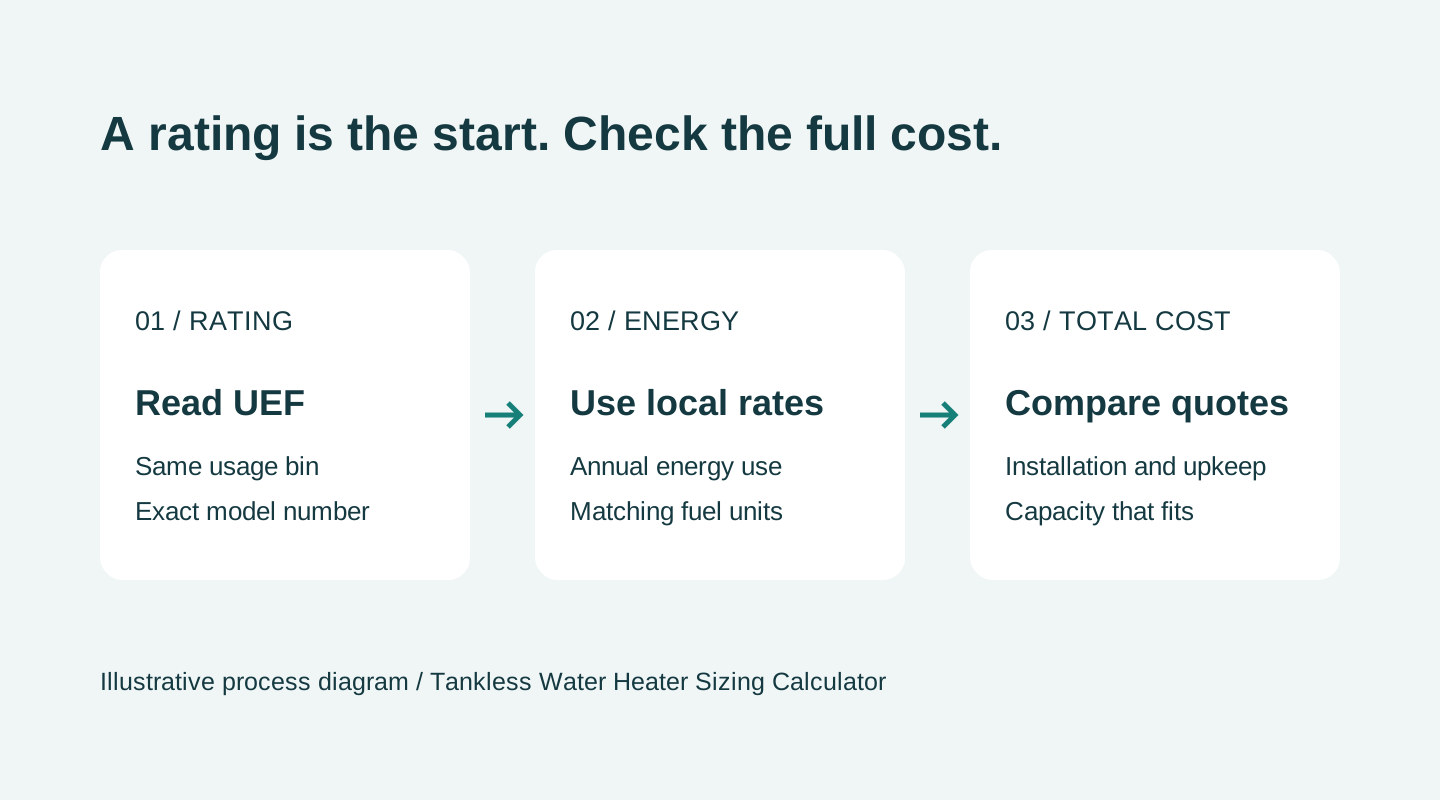
Use UEF to compare efficiency within the same usage group. Check annual energy use and local fuel prices to estimate running costs. Then add the installed price and upkeep to your comparison. For tankless units, check flow at your winter temperature rise. For tanks, check the first-hour rating. A high rating alone does not make a heater the cheapest choice for your home.
Read water heater efficiency ratings: EF and UEF
Uniform Energy Factor (UEF) is the current US water heater efficiency measure. Older pages may use Energy Factor (EF). The test method changed, so do not treat an old EF and a new UEF as the same scale. Look up the exact model rather than copying a rating from a similar unit.
UEF compares useful heat supplied in hot water with the energy used under a set test. A higher UEF means better efficiency within the same usage group. Those groups are called bins: very small, low, medium and high.
A rating from one bin is not a fair direct comparison with a rating from another. This maker's guide explains the UEF groups and the move from EF.
Put both model numbers side by side before you compare them. Record the fuel, heater type, usage bin and UEF. If the sales page leaves out the bin, check the maker's product sheet. This small check can stop a large rating on one page from winning an unfair comparison.
Use EnergyGuide to compare running costs
The yellow EnergyGuide label gives an estimate for energy use and yearly cost. It helps you compare similar appliances under the label's stated conditions. It is not a quote for your house. The FTC says actual costs depend on use and local energy prices.
For each model, save a copy of its label. Check that the model number matches the quote. Read the assumed energy rate and usage conditions before comparing the cost figures. Two labels from different years can use different fuel prices, even when the heaters use the same amount of energy.
If the label lists annual electricity use, multiply that use by your local price per kilowatt-hour, or kWh. With gas, use matching units: therms with a price per therm, for example. Include electricity for a gas model when its stated use includes a separate electric load. Do not multiply a gas volume in cubic feet by a price per therm without the correct conversion.
The DOE water heater certification database lists model data, including UEF and capacity fields. Use it to cross-check a model when a retailer's short listing is unclear. The maker's label and installation manual still matter for the exact unit you plan to buy.
Work through an example using local kWh prices
Here is a made-up electricity example to show the math. These numbers are assumptions, not measured use, product claims or current market rates. Assume the two labels use matching test conditions and both heaters meet the household's hot-water demand.
- Model A: annual electricity use of 3000 kWh.
- Model B: annual electricity use of two thousand kWh.
- Assumed local rate: 0.20 dollars per kWh, with fixed charges unchanged.
- Annual energy cost: A costs 600 dollars; B costs 400 dollars.
- Annual energy saving: 200 dollars for B under these assumptions.
Now assume B costs 1000 dollars more to buy and install. Divide that extra cost by the 200-dollar yearly saving. The simple payback is five years. This is an illustration of the method, not a forecast for either heater type.
Upkeep can alter that result. If B adds 50 dollars a year in service costs, the net yearly saving drops to 150 dollars. Simple payback becomes about 6.7 years. A lower local electricity price would also reduce the saving from using less power.
This method leaves out finance costs and future rate moves. It also leaves out repairs and the time worth of money. The method assumes that hot-water use stays the same. Use it as a first comparison, then put your own quotes and rates in place of every example number. Keep any fixed utility charge that will still apply to either choice outside the claimed saving.
Compare tankless with storage and heat pump water heaters
The heater type changes how heat reaches the water. A storage unit keeps hot water in a tank. Tankless units heat water as it flows, which avoids the standby heat loss of keeping a tank hot. That does not mean a tankless installation has no energy losses or no limit on flow. PNNL's gas tankless guide covers selection and installation checks.
A heat pump water heater uses electricity to move heat from nearby air into the water. That is why its UEF can exceed one. The rating does not mean that it creates energy. Room conditions, operating mode and use of backup resistance heat affect the result. PNNL explains heat pump ratings and the space these units need.
Compare water heater efficiency and fuel cost as separate steps. A heater that uses less energy may still face a higher price for each unit of fuel. A gas-to-electric switch needs an energy-cost comparison using both local rates. It also needs installed quotes that cover any required changes to the home.
Avoid a single ranking that calls one type cheapest for every household. Instead, compare models that fit the same home and demand. Check whether a quote includes venting and gas supply. Check electrical work and drainage too, plus permits where needed. The cheapest appliance price can leave out work that the other quote includes.
Check GPM and first-hour rating before you choose
Water heater efficiency does not replace sizing. A tankless unit needs to supply your peak hot-water flow at the required temperature rise. GPM means gallons per minute. Temperature rise is the gap between incoming water and the heater's outlet setting. PNNL recommends checking both against the maker's specifications, along with gas supply for a gas unit.
List the fixtures you expect to use at the same time. Use their hot-side demand rather than adding every tap in the house. Check the unit's flow chart at your winter inlet temperature. A headline maximum GPM figure may use a smaller temperature rise than your home needs. Our sizing calculator can help organize those inputs before you check the model's chart.
For a storage unit, the first-hour rating describes how much hot water it can supply over the first hour from a heated tank. Tank volume alone misses the heat added while water is being used. Check that rating against the busiest hour, and review recovery and operating mode for a heat pump tank. A model that cannot meet demand should leave your shortlist before a small running-cost advantage decides the sale.
Keep a UEF and cost comparison sheet
Save the evidence behind your choice so the figures remain easy to check. Use one row per exact model. Leave a blank where a quote has not supplied a fact; do not fill it with the figure from another size.
- Identity: maker and full model number, plus fuel and heater type.
- Efficiency: UEF, usage bin and the dated product sheet.
- Energy cost: annual use, label assumptions and local rates.
- Capacity: tankless flow at your temperature rise, or tank first-hour rating.
- Installed quote: equipment plus the work needed for that model.
- Upkeep: the maker's tasks and any quoted service cost.
Ask the installer to list exclusions in writing. Then compare the same scope of work. Keep incentives separate until you have checked the rules for your exact model and home. Check the purchase date too. A possible rebate should not silently reduce one quote while the other stays at full price.
FAQ
Is higher or lower UEF better?
A higher UEF means better efficiency within the same usage bin. Check the fuel and the model's hot-water capacity too. A rating alone cannot tell you which unit has the lowest running cost at your local rates. Use the annual energy estimate to price each suitable model.
Can I compare EF with UEF?
Do not treat EF and UEF as interchangeable ratings. They come from different test methods. Find the current model's UEF and usage bin where available. For an older heater, use its own label and known energy use as the starting point, and state any missing facts in your comparison.
Does a high UEF guarantee lower bills?
No. Bills depend on fuel prices and how much hot water you use. A more efficient unit can face a higher energy rate, added service costs or a larger installed price. Check energy cost first, then compare the full purchase and upkeep costs over the period you expect to keep it.
Why can a heat pump water heater have a UEF above one?
A heat pump moves heat from surrounding air into the tank instead of using electricity only to make heat. That lets the useful heat supplied exceed the electrical energy it uses. Check the room and mode requirements, since backup resistance heat and colder air can affect real performance.
Verdict on water heater efficiency and annual cost
Use water heater efficiency to narrow a fair set of models, then price their energy use at your own rates. Check capacity before comparing payback. Keep the label, model sheet and full installed quote together. The best choice for your home is a heater that meets demand at a cost you have checked, with no promised saving standing in for the math.